Flowers Foods, Inc (FLO) cut its dividend due to debt, leverage, and declining sales and income. Soft operating and financial results combined with a leveraged balance sheet pressured the dividend safety. The firm had a 23-year streak of increases and Dividend Contender status, which it lost after the cut.
The share price has declined since late 2022 with little interruption because of the challenges the company faced. Investors are arguably not currently interested in this equity and sold this dividend stock due to concerns about net debt, leverage, and operating results. Moreover, inflationary trends and continued economic uncertainty, with additional pressures from the regional conflicts in the Middle East and Ukraine, added to the company’s challenges.
Affiliate
Free Dividend Kings Spreadsheet from Sure Dividend, complete with Buy/Hold/Sell recommendations, dividend histories, and much more.
Overview of Flowers Foods
Flowers Foods, Inc. was founded in 1919 and is headquartered in Thomasville, Georgia. Today, it is a consumer packaged foods company focusing on bakery items. It sells baked foods nationally from its 44 bakeries to supermarkets, drug stores, and discount retailers. The company is the second largest packaged baked foods producer based on market share. Its easily recognized brands include Nature’s Own, Dave’s Killer Bread, Wonder, Sunbeam, and more. The firm also makes store brands.
Total revenue was $5,256 million in fiscal 2025 and $5,274 million in the past twelve months.
Dividend Cut Announcement
During the first quarter FY 2026 results announcement, on Thursday, May 21st, Flowers Foods Inc. (FLO) cut its dividend. The company’s quarterly dividend rate was $0.2475 per share before the announcement. The dividend is now $0.125 per common share, a 49.5% reduction. In the earnings release on May 12th, the company’s Chairman and CEO provided the following remarks,
“The comprehensive review of our brand portfolio, supply chain, and financial strategy announced last quarter is well underway and helping to further clarify how we allocate resources to strengthen our position and support the growth of our strongest brands,” McMullian added. “As part of this effort, we reset our quarterly dividend to $0.125 per share, or $0.50 per share on an annualized basis, allowing us to prioritize meaningful debt reduction while continuing to invest behind the brands, innovation, and capabilities that we believe will drive sustainable above-category growth over time. As we move forward and execute our strategy, we expect dividends to remain an important component of our overall shareholder value proposition. With respect to our 2026 outlook, we are reaffirming guidance and our team remains focused on disciplined execution, managing the areas of the business we can directly influence and delivering against our strategic and financial objectives for the year.”
Later, in the first quarter earnings call transcript, the Chairman and CEO stated,
“This brings me to capital allocation. As we noted on our previous call, a key component of our comprehensive review was an evaluation of our capital structure, balance sheet and financial flexibility through the lens of our growth agenda and long-term shareholder value creation. To execute our strategy from a position of strength, we’re resetting our dividend to an annual rate of $0.50 per share. This action allows us to reduce leverage and interest expense, enhance financial flexibility and create capacity to invest behind our leading brands and capabilities to drive above-category growth. As we increase available capital to reinvest in the business, we will take a disciplined and balanced approach to capital allocation, prioritizing high-return investments while continuing to return capital to shareholders. Importantly, we remain committed to maintaining a sustainable dividend as a core component of our overall shareholder value proposition.”
Effect of the Change
By cutting the dividend by 49.5%, Flower Foods wanted to decrease its quarterly and annual dividend distributions, thereby allowing it to reduce leverage and interest expense. The aim is seemingly to create more financial flexibility and to pursue high-return investments. Beyond these reasons, the firm’s revenue and income are declining because of pressure on consumers who are switching to lower-cost brands in the face of inflation and economic uncertainty.
The company had a 23-year streak of annual increases and was thus on the list of Dividend Contenders. By slashing its dividend by almost one-half, Flowers Foods lost its streak and status as a Dividend Contender. The result is that much less free cash flow (“FCF”) is required for the dividend distribution, allowing the company to direct cash flow to debt reduction, interest expense, and strategic priorities.
Challenges
Flowers Foods is faced with a difficult time because of its many acquisitions over the past decade, resulting in an increase in debt and leverage. In addition, inflationary pressures are affecting consumer spending and product choices.
Debt and Leverage
Flowers Foods is a leveraged firm with about $2.05 billion in net debt, which exceeds the firm’s market capitalization. It currently has approximately 4.41 times interest coverage and a leverage ratio of about 3.1 times. Notably, both values indicate that the company has too much debt. A consumer packaged food company’s leverage ratio should usually be 2.5X or less. It has a ‘BBB-/Baa3’ lower-medium investment grade rating, due to high leverage, slow growth, and lack of pricing power, but offset by the dividend cut and market share.
Inflation and Consumers
Inflation affects both Flowers Foods’ input costs and consumers. The company’s input costs are rising due to inflationary trends. The cost of freight, packaging, labor, and commodities are increasing faster than the firm can raise prices, which is common for most consumer packaged foods companies. Input commodities are influenced by weather, global conflicts, tariffs, and other events.
Apart from this, consumers are spending less because incomes are not keeping up with inflation. As a result, they may trade down to private label brands for grocery purchases. Notably, Flowers Foods, which focuses on its own brands and store brands baked foods, has lost volumes and thus market share over the past several quarters. In turn, this has pressured the top line, operating margins, and income.
Dividend Safety
Because of weaker revenue and earnings per share (“EPS”) losses, Flowers Foods’s dividend safety metrics were declining. Even though revenue has risen due to acquisitions, its EPS has varied wildly in the trailing ten years. Adjusted diluted EPS peaked at $1.31 in FY 2020 and was flat at between $1.20 and $1.30 for the next several years, before declining in 2025. Consensus analyst estimates are even lower at $0.83 per share in fiscal 2026.
As shown in the chart below from StockRover*, the dividend yield trended upward from early-2025 and crossed the 10% mark in early-2026. High values over this quantity are usually associated with companies facing operating and financial difficulties. Notably, the yield is still elevated, even after slashing the distribution by 49.5%. The dividend yield is now around 6.76%. The quarterly distribution rate is $0.125 per share. However, the yield is still more than the trailing 4-year average of 5.48% and substantially greater than that of the S&P 500 average.
Simultaneously, the payout ratio has crossed over the 100% threshold multiple times since late-2023, which indicated the firm could not pay the dividend over an extended period.
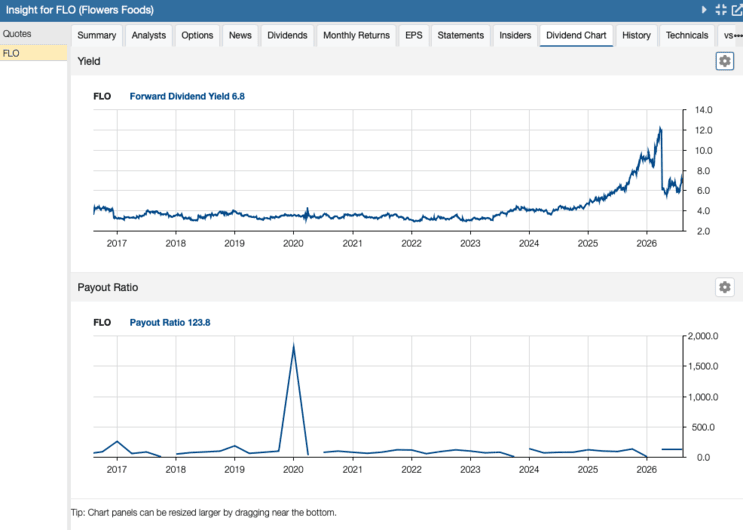
The lower rate will improve the payout ratio to about 60% based on estimated EPS of $0.83 and an annual dividend rate of $0.50. The annual dividend now requires about $106 million going forward ($0.50 yearly dividend x 212 million shares), compared to about $210 million last year. The free cash flow (“FCF”) was still covering the dividend requirement, but it will be improved now. I expect the yearly difference in cash flow requirements to allow Flowers Foods to meet its interest expense, while paying down debt.
Currently, dividend safety has increased dramatically and the payout is more secure now. That said, while there is no immediate risk for another dividend cut, Flowers Foods needs to improve its operating results and turn around sales and market share declines. Moreover, inflationary trends are impacting results, which may require efficiency initiatives.
Final Thoughts on Flowers Foods (FLO) Dividend Cut
Flowers Foods cut its dividend for multiple reasons. However, to summarize, it has too much debt, high leverage, and not enough interest coverage. Apart from the balance sheet concerns, declining sales volumes and market share losses have led to decreasing revenue, margins, and income. The combined effect has been aggravated by inflationary trends and economic uncertainty. Moreover, conflict in the Middle East and Ukraine will likely impact margins due to higher input costs.
The collective effect resulted in declining dividend safety metrics. As a result, Flowers Foods cut its dividend. However, I currently view the dividend as safe.
Related Articles on Dividend Power
Here are my recommendations:
Affiliates
- Simply Investing Report & Analysis Platform or the Course can teach you how to invest in stocks. Try it free for 14 days.
- Free Dividend Kings Spreadsheet from Sure Dividend, complete with Buy/Hold/Sell recommendations, dividend histories, and much more. It is an excellent resource for DIY dividend growth investors and retirees.
- Stock Rover is the leading investment research platform with all the fundamental metrics, screens, and analysis tools you need. Try it free for 14 days.
Receive a free e-book, “Become a Better Investor: 5 Fundamental Metrics to Know!” Join thousands of other readers !
*This post contains affiliate links meaning that I earn a commission for any purchases that you make at the Affiliates website through these links. This will not incur additional costs for you. Please read my disclosure for more information.
Prakash Kolli is the founder of the Dividend Power site. He is a self-taught investor, analyst, and writer on dividend growth stocks and financial independence. His writings can be found on Seeking Alpha, InvestorPlace, Business Insider, Nasdaq, TalkMarkets, ValueWalk, The Money Show, Forbes, Yahoo Finance, and leading financial sites. In addition, he is part of the Portfolio Insight and Sure Dividend teams. He was recently in the top 1.0% and 100 (73 out of over 13,450) financial bloggers, as tracked by TipRanks (an independent analyst tracking site) for his articles on Seeking Alpha.