
Key Takeaways
- Conagra cut its dividend by 50% due to declining volumes, high net debt, and economic uncertainty.
- The company’s share price has fallen significantly amid concerns over weak consumer demand and financial results.
- Weak revenue, input inflation, and increased debt pressures impacted Conagra’s operating performance.
- Despite the challenges, the dividend is now safer with improved liquidity and a forward payout ratio close to 50%.
- Overall, the Conagra dividend cut was necessary to stabilize financial performance and ensure future growth.
Conagra (CAG) cut its dividend due to declining volumes, input inflation, high net debt, too much leverage, and broader economic uncertainty. The combined effect pressured operating and financial results. The firm’s dividend has been constant since Q4 FY 2023, and it was eventually cut this year.
The share price has fallen significantly since early 2023. Investors sold this dividend stock due to concerns about weak consumer demand, poor top- and bottom-line results, debt, leverage, and a potential dividend cut. I currently view the dividend as safe.
Affiliate
Free Dividend Kings Spreadsheet from Sure Dividend, complete with Buy/Hold/Sell recommendations, dividend histories, and much more.
Conagra (CAG) Dividend Metrics Pre vs. Post Cut
| Key Dividend Metric | Pre-Cut Level | Post-Cut Level | Strategic Impact & Safety Outlook |
|---|---|---|---|
| Quarterly Payout | $0.350 / share | $0.175 / share | 50.0% payout reduction |
| Annual Cash Required | ~$669.7 Million | ~$335.3 Million | Frees up ~$334.4M annually for debt pay down |
| Forward Dividend Yield | ~9.0%+ (Stressed) | ~4.5% – 5.2% | Aligns yield closer to consumer staples peers |
| Forward Payout Ratio | >85% of FCF | 50% – 55% Target | Restores payout coverage to manageable levels |
| Credit Rating | BBB- / Baa3 | BBB- / Baa3 | Protects lower-medium investment grade status |
Overview of Conagra Corporation
Conagra Brands, Inc. was founded in 1919 and is headquartered in Chicago, IL. It is a consumer packaged foods company that operates mainly in the United States. The firm operates through four segments: Grocery & Snacks (41% of revenue), Refrigerated & Frozen (41% of revenue), International (8% of revenue), and Foodservice (10% of revenue). It owns many well-known brands including Birdseye, Duncan Hines, Slim Jim, Marie Callender’s, Healthy Choice, Hunt’s, and more.
Total revenue was $11,282 million in fiscal year (“FY”) 2026 and in the last twelve months (“LTM”).
Dividend Cut Announcement
During the fourth quarter of FY 2026 and just prior to the earnings release, on Wednesday, July 15th, Conagra Inc. (CAG) cut its dividend. The company’s quarterly dividend rate was $0.35 per share before the announcement. The dividend is now $0.175 per common share, a 50% reduction. In the announcement on July 15th, the company stated,
“Resetting our dividend to an annualized rate of $0.70 per share proactively realigns our capital allocation, accelerates progress toward our leverage target, supports critical investments, and strengthens our financial flexibility, including the ability to shape the portfolio over time. Our commitment to shareholders hasn’t changed; our objective remains a balanced capital allocation, with a dividend that returns meaningful capital to shareholders and enables the dividend to grow alongside earnings over time. This decision aligns with our priorities to stabilize and restore margins, increase investments in our brands and supply chain, and reduce complexity, and we are confident it is the right decision for the long-term success of Conagra.”
Later, in the second quarter earnings call transcript, the CFO stated,
“As announced in our press release today, our Board of Directors approved a quarterly dividend at an annualized rate of $0.70 per share, representing a reduction of 50% versus our prior dividend rate. The revised dividend is expected to provide approximately $335 million of additional discretionary cash on an annualized basis. We intend to deploy this across our highest priorities, including reducing debt, supporting strategic brand-building investments and funding key supply chain and modernization initiatives, as John mentioned.”
“From a balance sheet perspective, this action will accelerate progress towards our long-term leverage target of 3x while supporting our investment-grade credit rating. It also improves our overall financial flexibility, increasing our capacity to strengthen the portfolio and drive long-term profitable growth. We remain committed to returning cash to shareholders through the dividend. This action resets our dividend payout ratio near our long-term target of 50% to 55%, enabling the dividend to grow with earnings going forward.”
Effect of the Change
By cutting the dividend by 50%, Conagra sought to decrease its quarterly and annual dividend distributions and substantially increase its financial flexibility. A major consideration is that the balance sheet is leveraged with low interest coverage. The firm is also experiencing lower revenue, earnings, and free cash flow (“FCF”) due to weak consumer demand in the face of higher gas prices and inflation. In addition, broader economic uncertainty has impacted results.
The company’s dividend rate has been constant since Q4 of FY 2024, so it did not have a streak of increases. The firm was not a dividend growth stock. The result is that less free cash flow (“FCF”) is required for the dividend distribution, allowing the company to reduce total debt and leverage while investing in its businesses.
Challenges
Conagra is facing a challenging business environment because of soft consumer demand. They are increasingly constrained by inflation outpacing wage increases. Additionally, the balance sheet is leveraged, and interest coverage is suboptimal, while revenue, earnings, and FCF are under pressure.
Inflation and Consumers
Inflation affects both Conagra’s input costs and consumers. Customers are spending less because incomes are not keeping up with inflation. As a result, they are often trading down to store or private-label brands. In addition, inflation affects Conagra’s input costs due to rising commodity, labor, freight, packaging, and energy prices. The net result is declining volumes and weak pricing power.
Debt and Leverage
Conagra is a leveraged firm with over $7.25 billion in net debt. Although net debt has decreased over the past few years, it is still elevated, resulting in a leverage ratio of 4.03X and interest coverage of only 3.45X. The fact that the leverage ratio has risen, while net debt has fallen, indicates that the firm’s operating performance has weakened. Conagra has, however, an investment-grade credit rating of BBB-/Baa3, which is lower-medium grade. The firm is faced with operational challenges, cost pressures, and still high leverage.
Operating Performance
Conagra has had persistent operating performance challenges in the past few years. The company’s revenue, earnings, and FCF have trended downward due to volume declines and input inflation. This is further seen in the falling gross and operating margins. These trends do not show signs of reversing in the near future. Furthermore, the firm took over $2 billion in impairment charges in fiscal year 2026.
Dividend Safety
Because of weaker revenue and earnings per share (“EPS”), Conagra’s dividend safety metrics were poor. Revenue peaked in 2023 and has fallen since then. It is now about $1 billion lower than in 2023. EPS has been volatile, with the peak occurring in 2021 before becoming negative in FY 2026 due to weakening results and impairment charges. Consensus estimates indicate $1.45 per share in FY 2027, which would be an improvement.
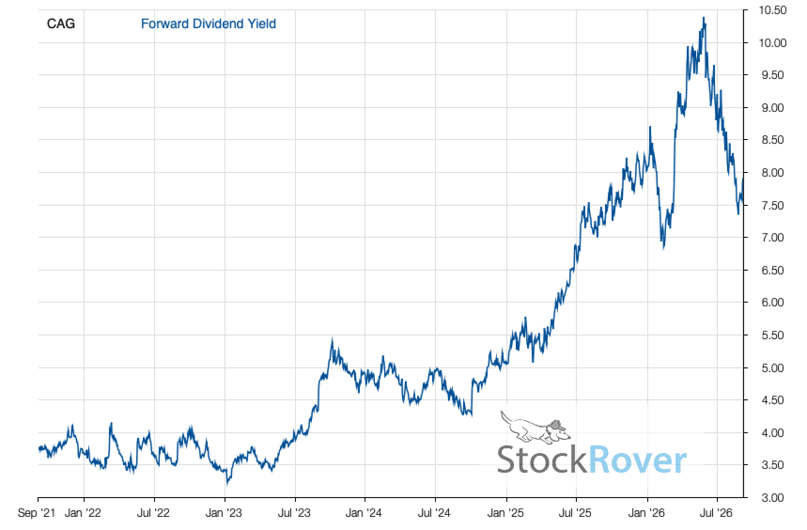
As shown in the chart below from StockRover*, the dividend yield increased rapidly to over 10.2% in late May of FY 2026. This value is often viewed as critical, and it is associated with companies facing operating and financial difficulties. Also, it was much greater than the 4-year average of 5.71%. After reducing the dividend by exactly 50%, the forward dividend yield is now around 4.52%, a much more reasonable value. The quarterly rate is $0.175 per share. However, the yield is still appreciably greater than that of the S&P 500 average.
The annual dividend now requires about $335.3 million ($0.70 yearly dividend x 479 million shares), compared to $669.7 million in FY 2026. The lower rate will improve the payout ratio, which has reached over 100% and was negative last fiscal year before the cut, indicating that earnings were not covering the dividend. Additionally, FCF had declined to $979 million in FY 2026, down from $1,628 million in FY 2024. We expect the yearly difference in cash flow requirements to enhance liquidity and allow Conagra to pay down debt, reduce leverage, and invest in brands and the supply chain.
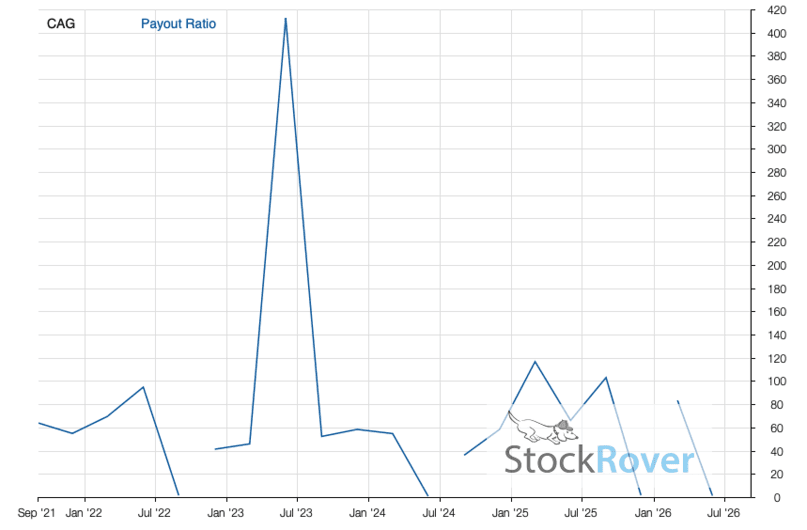
The dividend is in a better position and more secure now. Although the safety is not high, the forward payout ratios are now close to 50%, and cash flow easily covers the requirement. I do not view the dividend as a risk for another cut in the foreseeable future.
Final Thoughts on Conagra (CAG) Dividend Cut
Weak results over several years due to a stressed consumer led to volume declines, negatively impacting revenue, EPS, and FCF. Next, this was exacerbated by the lack of pricing power and input inflation, which caused gross and operating margins to contract. Beyond this, Conagra’s net debt and leverage were too high, while interest coverage was low. As a result, Conagra cut its dividend. The dividend cut was arguably needed to stabilize financial performance. I currently believe the dividend is safe.
Conagra Dividend Cut Frequently Asked Questions
Conagra cut its dividend to lower its leverage ratio, reduce total debt, and cope with softening consumer volumes and persistent input cost inflation. The cut resets its dividend payout ratio to a sustainable target of 50% to 55% of earnings.
Following the 50% dividend reduction to an annualized $0.70 per share, Conagra’s forward dividend yield trades in the 4.5% to 5.2% range, depending on share price fluctuations.
Yes, the reset dividend is significantly safer. By cutting annual dividend distributions by over $334 million, free cash flow now comfortably covers the requirement, substantially reducing the risk of a secondary cut.
No. Conagra was not a Dividend King or Aristocrat, as its dividend history included prior periods of flat payouts rather than consecutive annual increases.
Related Articles on Dividend Power
Here are my recommendations:
Affiliates
- Simply Investing Report & Analysis Platform or the Course can teach you how to invest in stocks. Try it free for 14 days.
- Free Dividend Kings Spreadsheet from Sure Dividend, complete with Buy/Hold/Sell recommendations, dividend histories, and much more. It is an excellent resource for DIY dividend growth investors and retirees.
- Stock Rover is the leading investment research platform with all the fundamental metrics, screens, and analysis tools you need. Try it free for 14 days.
Receive a free e-book, “Become a Better Investor: 5 Fundamental Metrics to Know!” Join thousands of other readers !
*This post contains affiliate links meaning that I earn a commission for any purchases that you make at the Affiliates website through these links. This will not incur additional costs for you. Please read my disclosure for more information.
Prakash Kolli is the founder of the Dividend Power site. He is a self-taught investor, analyst, and writer on dividend growth stocks and financial independence. His writings can be found on Seeking Alpha, InvestorPlace, Business Insider, Nasdaq, TalkMarkets, ValueWalk, The Money Show, Forbes, Yahoo Finance, and leading financial sites. In addition, he is part of the Portfolio Insight and Sure Dividend teams. He was recently in the top 1.0% and 100 (73 out of over 13,450) financial bloggers, as tracked by TipRanks (an independent analyst tracking site) for his articles on Seeking Alpha.