Key Takeaways
- The dividend kings list includes 54 companies that have raised dividends for at least 50 consecutive years, showcasing a success rate of about 0.9%.
- Dividend Kings currently have an average P/E ratio of 24.5X and an average dividend yield of 2.72%.
- No Dividend King has cut their dividend during the COVID-19 pandemic, highlighting their financial resilience.
- In 2025, Automatic Data Processing and others joined the list, while no companies were removed that year.
- The Dividend Kings demonstrate the importance of long-term dividend growth for investors seeking reliable passive income.
What Are The Dividend Kings?
The Dividend Kings in 2026 are stocks on United States stock exchanges that have increased their dividends for at least 50 consecutive years. To attain the 50-year mark is not easy; the list of Dividend Kings is very select. Only 54 companies on the New York Stock Exchange (NYSE) and NASDAQ have done so. This number is out of nearly 6,000 companies listed on the NYSE and NASDAQ, indicating a success rate of approximately 0.9%. It is also seven more than in 2025.
The number of Dividend Kings increases slightly to 55 if we include over-the-counter (OTC) stocks. The total universe of U.S. stocks also goes up to about 12,000, indicating an even lower success rate of about 0.45% for companies to achieve Dividend King status. A few lists include even more equities on the list because of spinoffs and Canadian stocks, but we exclude them here. Also, a few discrepancies exist for the Dividend Kings list; we discuss those below.
Affiliate
Stock Rover is an award winning investment research platform.
- The site has 8,500+ stocks, 4,000 ETFs, and 40,000 mutual funds.
- Access to 650+ metrics, financial data, market news, stock and fund ratings, fair value, margin of safety, etc.
- Includes brokerage integration, portfolio tracking, rebalancing, watchlists, alerts, future income forecasts, etc.
Click here to try Stock Rover for free (14-day free trial).
Market Update for the 2026 Dividend Kings
The Dividend Kings are currently trading at an elevated valuation of a trailing average price-to-earnings ratio of about 24.5X. This multiple is down from its peak of more than 31X in May 2021. The forward P/E ratio is about 17.17X.
The current average dividend yield is about 2.72%. The average trailing 10-year dividend growth rate is about 5.85%, and the average past 5-year growth rate is around 5.33%. The mean payout ratio is approximately 64.48%. The average market cap is currently $82,286 million.
Currently, the Dividend King with the highest yield is Universal (UVV) at about 7.8%, and the one trading with the lowest earnings multiple in the trailing twelve months (“TTM”) is Cincinnati Financial (CINF), while it is H.B Fuller (FUL) on a forward basis.
The updated, selected financial data and dividend earnings calendars for each stock on the Dividend Kings list are in the tables below. The most recent dividend increases are also available to search.
According to Stock Rover*, over the trailing 1-year period, the Dividend Kings have returned +10.0% (blue line) compared to +17.7% for the S&P 500 Index benchmark (red line), as seen in the chart below. Over the trailing 5-years, the Dividend Kings have returned +40.7%, while the S&P 500 Index has returned +92.4%.
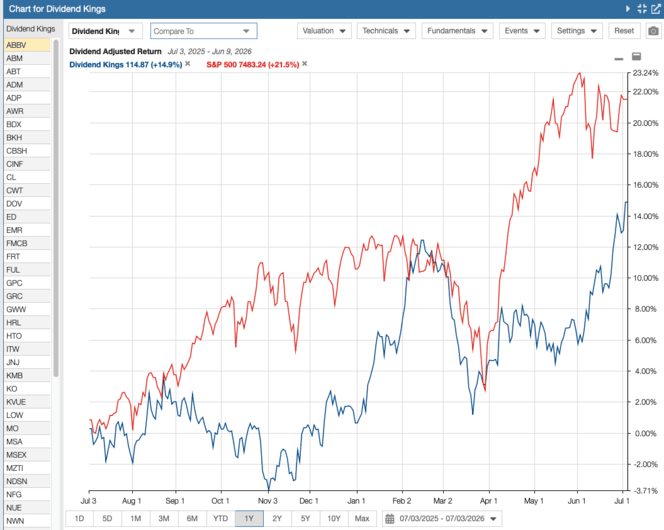
Source: Stock Rover*
List of Dividend Kings in 2026
Stock Rover* was used to create this table.
| Ticker | Company Name | No. Years | Dividend Yield (%) | 10-yr Dividend Growth Rate (%) | Payout Ratio (%) | TTM P/E Ratio | Market Cap (millions) |
|---|---|---|---|---|---|---|---|
| ABBV | AbbVie | 53 | 2.60 | 11.70 | 190.40 | 75.3 | $471,272 |
| ABM | ABM Indus | 57 | 2.40 | 5.80 | 40.70 | 17.5 | $2,836 |
| ABT | Abbott Laboratories | 53 | 2.60 | 9.30 | 78.70 | 31.7 | $169,854 |
| ADM | Archer-Daniels-Midland | 52 | 2.50 | 5.70 | 56.40 | 22.5 | $39,621 |
| ADP | Automatic Data Processing | 50 | 2.60 | 12.40 | 60.50 | 24 | $103,960 |
| AWR | American States Water | 70 | 2.70 | 9.30 | 55.10 | 22.4 | $3,232 |
| BDX | Becton Dickinson | 53 | 2.30 | 4.80 | 126.20 | 41.9 | $49,111 |
| BKH | Black Hills | 55 | 4.00 | 5.30 | 69.50 | 17.8 | $5,394 |
| CBSH | Commerce Bancshares | 56 | 2.00 | 7.10 | 26.60 | 13.4 | $7,855 |
| CINF | Cincinnati Financial | 52 | 2.30 | 7.00 | 16.90 | 7.7 | $25,029 |
| CL | Colgate-Palmolive | 65 | 2.40 | 3.10 | 82.60 | 34.4 | $69,553 |
| CWT | California Water Servs Gr | 63 | 2.90 | 6.90 | 57.00 | 20.4 | $2,816 |
| DOV | Dover | 58 | 1.10 | 1.80 | 24.90 | 23.2 | $25,842 |
| ED | Consolidated Edison | 69 | 3.30 | 2.90 | 57.00 | 17.3 | $38,876 |
| EMR | Emerson Electric | 51 | 1.40 | 1.60 | 47.80 | 35.3 | $90,028 |
| FMCB | Farmers & Merchants | 68 | 1.50 | -1.60 | 14.60 | 10.4 | $1,003 |
| FRT | Federal Realty Investment | 59 | 4.40 | 1.70 | 91.10 | 21.5 | $9,227 |
| FUL | H.B. Fuller | 57 | 1.90 | 5.80 | 26.40 | 14.1 | $2,725 |
| GPC | Genuine Parts | 51 | 3.30 | 4.90 | n/a | n/a | $17,560 |
| GRC | Gorman-Rupp | 55 | 1.00 | 6.10 | 32.00 | 32.6 | $2,039 |
| GWW | W.W. Grainger | 69 | 0.80 | 7.40 | 23.60 | 32.5 | $60,080 |
| HRL | Hormel Foods | 52 | 5.90 | 7.30 | 188.30 | 32.1 | $10,940 |
| HTO | H2O America | 52 | 3.00 | 8.10 | 60.10 | 20.6 | $2,434 |
| ITW | Illinois Tool Works | 59 | 2.60 | 10.20 | 58.20 | 24.2 | $76,081 |
| JNJ | Johnson & Johnson | 61 | 2.10 | 5.30 | 60.00 | 29.5 | $613,993 |
| KMB | Kimberly-Clark | 62 | 5.30 | 3.40 | 86.40 | 19.1 | $32,183 |
| KO | Coca-Cola | 53 | 2.50 | 4.20 | 62.50 | 25.9 | $370,750 |
| KVUE | Kenvue | 63 | 4.80 | n/a | 96.50 | 20.5 | $33,786 |
| LOW | Lowe's Companies | 62 | 2.70 | 13.60 | 41.00 | 15.5 | $103,048 |
| MO | Altria Group | 62 | 6.50 | 6.20 | 89.30 | 14.4 | $114,460 |
| MSA | MSA Safety | 61 | 1.20 | 5.00 | 26.40 | 22.7 | $7,038 |
| MSEX | Middlesex Water | 55 | 2.70 | 6.10 | 54.80 | 20.4 | $996 |
| MZTI | The Marzetti | 54 | 4.00 | 7.20 | 56.60 | 14.4 | $2,734 |
| NDSN | Nordson | 52 | 1.10 | 13.30 | 33.00 | 33.8 | $18,615 |
| NFG | National Fuel Gas | 61 | 2.80 | 3.20 | 29.80 | 10.9 | $7,446 |
| NUE | Nucor | 54 | 0.90 | 4.10 | 17.80 | 20 | $56,961 |
| NWN | Northwest Natural Hldg | 52 | 4.20 | 0.50 | 65.40 | 15.8 | $1,997 |
| PEP | PepsiCo | 69 | 4.70 | 7.00 | 75.20 | 16.5 | $171,580 |
| PG | Procter & Gamble | 53 | 2.90 | 5.00 | 63.10 | 22.4 | $344,707 |
| PH | Parker Hannifin | 68 | 0.80 | 12.20 | 25.60 | 34.6 | $124,209 |
| PNR | Pentair | 53 | 2.00 | -2.30 | 25.90 | 13.6 | $8,449 |
| PPG | PPG Indus | 68 | 2.80 | 6.30 | 40.50 | 15.3 | $23,679 |
| RLI | RLI | 51 | 1.30 | 6.10 | 13.80 | 11.8 | $5,142 |
| RPM | RPM International | 57 | 2.20 | 7.00 | 39.90 | 18.2 | $12,537 |
| SCL | Stepan | 57 | 2.50 | 7.60 | n/a | n/a | $1,418 |
| SPGI | S&P Global | 52 | 1.00 | 10.40 | 23.50 | 24.1 | $116,779 |
| SWK | Stanley Black & Decker | 57 | 3.70 | 3.80 | 81.00 | 22 | $13,589 |
| SYY | Sysco | 56 | 2.80 | 5.90 | 59.10 | 21.2 | $38,098 |
| TGT | Target | 54 | 3.00 | 6.80 | 47.10 | 16 | $70,111 |
| TNC | Tennant | 58 | 1.80 | 4.50 | 118.90 | 65.6 | $1,162 |
| TR | Tootsie Roll Industries | 53 | 1.00 | 3.00 | 28.10 | 29.6 | $2,801 |
| UBSI | United Bankshares | 50 | 3.30 | 1.40 | 41.00 | 12.6 | $6,274 |
| UVV | Universal | 54 | 7.80 | 4.60 | 431.60 | 56.2 | $1,063 |
| WMT | Walmart | 52 | 0.90 | 4.00 | 34.80 | 38.8 | $850,497 |
Dividend Calendar for the Dividend Kings 2026
Stock Rover* was used to create this table.
| Ticker | Company | Ex‑Div. Date | Div. Record Date | Div. Payment Date | Dividend Frequency | Next Div. Payment Per Share | Fwd. Div. Per Share |
|---|---|---|---|---|---|---|---|
| ABBV | AbbVie | 10/15/26 | 10/15/26 | 11/16/26 | 4 | $1.73 | $6.92 |
| ABM | ABM Indus | 10/1/26 | 10/1/26 | 11/2/26 | 4 | $0.29 | $1.16 |
| ABT | Abbott Laboratories | 10/15/26 | 10/15/26 | 11/16/26 | 4 | $0.63 | $2.52 |
| ADM | Archer-Daniels-Midland | 8/19/26 | 8/19/26 | 9/9/26 | 4 | $0.52 | $2.08 |
| ADP | Automatic Data Processing | 9/11/26 | 9/11/26 | 10/1/26 | 4 | $1.70 | $6.80 |
| AWR | American States Water | 8/17/26 | 8/17/26 | 9/2/26 | 4 | $0.55 | $2.18 |
| BDX | Becton Dickinson | 9/9/26 | 9/9/26 | 9/30/26 | 4 | $1.05 | $4.20 |
| BKH | Black Hills | 8/17/26 | 8/17/26 | 9/1/26 | 4 | $0.70 | $2.81 |
| CBSH | Commerce Bancshares | 9/4/26 | 9/4/26 | 9/22/26 | 4 | $0.28 | $1.10 |
| CINF | Cincinnati Financial | 9/23/26 | 9/23/26 | 10/15/26 | 4 | $0.94 | $3.76 |
| CL | Colgate-Palmolive | 10/20/26 | 10/20/26 | 11/13/26 | 4 | $0.53 | $2.12 |
| CWT | California Water Servs Gr | 8/10/26 | 8/10/26 | 8/21/26 | 4 | $0.34 | $1.34 |
| DOV | Dover | 8/31/26 | 8/31/26 | 9/15/26 | 4 | $0.52 | $2.10 |
| ED | Consolidated Edison | 8/19/26 | 8/19/26 | 9/15/26 | 4 | $0.89 | $3.51 |
| EMR | Emerson Electric | 8/14/26 | 8/14/26 | 9/10/26 | 4 | $0.56 | $2.22 |
| FMCB | Farmers & Merchants | 9/11/26 | 9/11/26 | 10/1/26 | 4 | $5.60 | $22.40 |
| FRT | Federal Realty Investment | 10/1/26 | 10/1/26 | 10/15/26 | 4 | $1.16 | $4.64 |
| FUL | H.B. Fuller | 10/15/26 | 10/15/26 | 10/29/26 | 4 | $0.25 | $0.98 |
| GPC | Genuine Parts | 9/4/26 | 9/4/26 | 10/2/26 | 4 | $1.06 | $4.25 |
| GRC | Gorman-Rupp | 8/14/26 | 8/14/26 | 9/10/26 | 4 | $0.19 | $0.76 |
| GWW | W.W. Grainger | 8/10/26 | 8/10/26 | 9/1/26 | 4 | $2.49 | $9.96 |
| HRL | Hormel Foods | 10/13/26 | 10/13/26 | 11/16/26 | 4 | $0.29 | $1.17 |
| HTO | H2O America | 8/10/26 | 8/10/26 | 9/1/26 | 4 | $0.44 | $1.76 |
| ITW | Illinois Tool Works | 9/30/26 | 9/30/26 | 10/9/26 | 4 | $1.72 | $6.88 |
| JNJ | Johnson & Johnson | 8/25/26 | 8/25/26 | 9/8/26 | 4 | $1.34 | $5.36 |
| KMB | Kimberly-Clark | 9/4/26 | 9/4/26 | 10/2/26 | 4 | $1.28 | $5.12 |
| KO | Coca-Cola | 9/15/26 | 9/15/26 | 10/1/26 | 4 | $0.53 | $2.12 |
| KVUE | Kenvue | 9/21/26 | 9/21/26 | 10/2/26 | 4 | $0.21 | $0.84 |
| LOW | Lowe's Companies | 10/21/26 | 10/21/26 | 11/4/26 | 4 | $1.25 | $5.00 |
| MO | Altria Group | 9/15/26 | 9/15/26 | 10/9/26 | 4 | $1.11 | $4.44 |
| MSA | MSA Safety | 8/14/26 | 8/14/26 | 9/10/26 | 4 | $0.54 | $2.16 |
| MSEX | Middlesex Water | 8/17/26 | 8/17/26 | 9/1/26 | 4 | $0.36 | $1.44 |
| MZTI | The Marzetti | 9/8/26 | 9/8/26 | 9/30/26 | 4 | $1.00 | $4.00 |
| NDSN | Nordson | 9/10/26 | 9/10/26 | 10/2/26 | 4 | $0.94 | $3.76 |
| NFG | National Fuel Gas | 9/30/26 | 9/30/26 | 10/15/26 | 4 | $0.56 | $2.22 |
| NUE | Nucor | 9/30/26 | 9/30/26 | 11/10/26 | 4 | $0.56 | $2.24 |
| NWN | Northwest Natural Hldg | 7/31/26 | 7/31/26 | 8/14/26 | 4 | $0.49 | $1.97 |
| PEP | PepsiCo | 9/4/26 | 9/4/26 | 9/30/26 | 4 | $1.48 | $5.92 |
| PG | Procter & Gamble | 7/24/26 | 7/24/26 | 8/17/26 | 4 | $1.09 | $4.35 |
| PH | Parker Hannifin | 8/31/26 | 8/31/26 | 9/11/26 | 4 | $2.00 | $8.00 |
| PNR | Pentair | 10/23/26 | 10/23/26 | 11/6/26 | 4 | $0.27 | $1.08 |
| PPG | PPG Indus | 8/10/26 | 8/10/26 | 9/11/26 | 4 | $0.74 | $2.96 |
| RLI | RLI | 8/31/26 | 8/31/26 | 9/15/26 | 4 | $0.18 | $0.72 |
| RPM | RPM International | 7/14/26 | 7/14/26 | 7/31/26 | 4 | $0.54 | $2.16 |
| SCL | Stepan | 9/1/26 | 9/1/26 | 9/15/26 | 4 | $0.40 | $1.58 |
| SPGI | S&P Global | 11/25/26 | 11/25/26 | 12/10/26 | 4 | $0.97 | $3.88 |
| SWK | Stanley Black & Decker | 9/8/26 | 9/8/26 | 9/22/26 | 4 | $0.84 | $3.36 |
| SYY | Sysco | 10/2/26 | 10/2/26 | 10/23/26 | 4 | $0.55 | $2.20 |
| TGT | Target | 11/10/26 | 11/11/26 | 12/1/26 | 4 | $1.16 | $4.64 |
| TNC | Tennant | 8/31/26 | 8/31/26 | 9/15/26 | 4 | $0.31 | $1.24 |
| TR | Tootsie Roll Industries | 10/7/26 | 10/7/26 | 10/16/26 | 4 | $0.09 | $0.36 |
| UBSI | United Bankshares | 9/11/26 | 9/11/26 | 10/1/26 | 4 | $0.38 | $1.52 |
| UVV | Universal | 10/9/26 | 10/12/26 | 11/2/26 | 4 | $0.83 | $3.32 |
| WMT | Walmart | 12/11/26 | 12/11/26 | 1/4/27 | 4 | $0.25 | $0.99 |
Are The Dividend Kings Safe Investments?
The Dividend Kings are successful companies. They have survived periods of inflation, stock market crashes, global crises, and deep recessions. In the past 50+ years, their dividends have survived seven recessions: the Vietnam War, the Gulf War, the fall of the Berlin Wall and the Soviet Union, 9/11 in 2001, the dot-com bust, the Great Recession, and the COVID-19 pandemic.
The 2026 Dividend Kings may not have grown revenue and earnings per share yearly, but they raised the dividend without fail. This length of time points to the durability of their businesses and the sustainability of their dividends. This fact is essential for investors seeking to produce passive income for retirement or build wealth. Moreover, dividends are vital since they are a significant component of total returns.
Despite some close calls, no Dividend King has cut or suspended its dividend due to the COVID-19 pandemic. However, 2024 was a far worse year because of rising interest rates, poor business decisions, and a changing economic landscape. In 2024, three companies fell off the list, the most since we started tracking the Kings, including 3M Company (MMM), Leggett & Platt (LEG), and Telephone Data Systems (TDS). Of these three, 3M was the most surprising because of its 66-year streak at the time.
Reportedly, before 2024, the last Dividend King to leave the dividend constant and fall off the list was Diebold in 2014, now known as Diebold Nixdorf (DDB). The company eventually cut the dividend. Before Diebold, AON plc (AON) was removed from the list in 2003. A few companies have fallen off the list because another company acquired them.
Nevertheless, the persistence of the dividend for the Dividend Kings demonstrates these companies’ success and their ability to return cash to shareholders through dividends.
Additions to the Dividend Kings in 2025
In 2025, Automatic Data Processing (ADP), Pentair (PNR), RLI (RLI), and United Bankshares (UBSI) were added to the list of Dividend Kings.
Automatic Data Processing is a large payroll and human resources outsourcing firm.
Pentair is a manufacturer of pumps, filtration systems, and other water handling products.
RLI is an insurance holding company that provides property, casualty, and surety insurance products.
United Bancshares is a small community, commercial, and mortgage bank with branches in the mid-Atlantic and Southeast.
Deletions to the Dividend Kings in 2025
No stocks were removed from the Dividend Kings list in 2025.
Other Dividend Stock Lists
I have also written articles with several other lists and analyses on US dividend growth stocks, including:
- Dividend Aristocrats List
- Dividend Champions List
- Dividend Contenders List
- Dividend Challengers List
- Dogs of the Dow in 2026
For Canadian stocks, I have written about
For UK stocks, I have written about
Other dividend stock lists
FAQs About the 2026 Dividend Kings
Which Dividend King has the Longest Streak of Increases?
The longest track record as a Dividend King is American States Water Company (AWR), with a 70-year history of dividend increases.
Not surprisingly, water utilities are highly represented on this list. They provide an essential product for consumers and industries. The business does not grow fast, but it grows as the population increases. The market and dividend growth investors have broadly recognized this point now, and water utilities often trade at elevated valuations while exhibiting low volatility.
There were four water utilities on this list at the start of 2019. However, Connecticut Water Service (CTWS) was acquired by SJW Corp (SJW) in 2019. This acquisition reduced the number to three: American States Water, California Water Service Group (CWT), and SJW Group (SJW). In addition, Northwest Natural Holding Company (NWN) is a multi-utility with a water subsidiary. Middlesex Water may also be on the list, but we exclude it for now.
Related Articles About Water Utilities on Dividend Power
Only One REIT on the Dividend Kings 2026 List
Only one real estate investment trust (REIT) is on the list, Federal Realty Investment Trust (FRT). The firm is a shopping center REIT that operates in eight metropolitan areas.
In addition, no master limited partnerships (MLPs) exist on the list.
Related Articles About Federal Realty Investment Trust (FRT) on Dividend Power
What is the difference between a Dividend King and a Dividend Aristocrat?
Many companies from the S&P 500 Dividend Aristocrats list are on the 2026 Dividend Kings list. A Dividend Aristocrat is a company that has raised its dividend for at least 25 consecutive years with market capitalization and liquidity requirements. A Dividend King must only have increase their annual distribution for 50 years. A company doesn’t need to be a Dividend Aristocrat to be a Dividend King.
Market Capitalization of the 2026 Dividend Kings
Interestingly, the list is not dominated by large-cap companies but includes quite a few mid-cap companies ($2 billion – $10 billion) and small-cap companies ($300 million – $2 billion).
The largest company by market capitalization on the Dividend Kings list is Walmart (WMT), with a market cap of about $954 billion. It was Johnson & Johnson for many years, but divestments and a declining share price have reduced its market capitalization. Conversely, the smallest company on the Dividend Kings list by market capitalization is Gorman-Rupp (GRC), with a market cap of about $967 million.
Lastly, one over-the-counter stock could be on the Dividend Kings list: Farmers & Merchants Bancorp (FMCB). It is smaller than Gorman Rupp.
What Do I Like About the Dividend Kings?
The Dividend King list in 2026 serves as a screen for further investigating a stock for a dividend growth portfolio. It lists companies with stable businesses and competitive advantages that have consistently returned cash to shareholders through dividends for an extended period. As a dividend growth investor, this is a place to start.
Some investors ask, “What’s the big deal about the Dividend Kings?” It measures success and diligence in returning cash to shareholders through dividends. These companies are not the highest-growth ones, but they grow over time. Moreover, the management teams are committed to paying dividends, a significant component of projected investor returns.
In addition, the Dividend Kings list changes only very slowly. On average, there are a few additions each year. However, the Dividend Kings exhibit persistence. Once a company is on the list, it tends to stay on it. This fact is probably due to the effort by each company’s management to maintain the dividend.
Are Companies Ever Deleted from the Dividend Kings List?
Sometimes, companies are deleted from the Dividend Kings list due to mergers and acquisitions. For instance, Vectren and Connecticut Water Service were removed in 2019 after being acquired. CenterPoint Energy (CNP) acquired Vectren, and SJW Group (SJW), another Dividend King, acquired Connecticut Water Service.
However, some companies do fall off the list for not raising the dividend or, even worse, for cutting or suspending it. In the past, this has included Winn-Dixie (WINN), Ohio Casualty Corp (eventually acquired), Aon plc (AON), Integrys Energy Group (TEG), Masco (MAS), and Diebold (DBD, which went into restructuring and emerged in August 2023), 3M Company, Leggett & Platt, and Telephone and Data Systems.
Readers can learn more on the Dividend Growth Investor blog about the evolution of the Dividend Kings list over the years. However, most of these companies generally had several years of operational difficulties or high leverage. Eventually, this led to a dividend freeze or cut and to the subsequent removal from the list. The bottom line is that earnings per share (EPS) and free cash flow (FCF) must grow over time for a company to become a Dividend King.
Dividend Kings Historical Performance
In absolute terms, the Dividend Kings have had a solid performance. The Dividend Kings have outperformed the S&P 500 Index, with lower volatility over the 20 years from 1999 to 2019. During this time, the 29 Dividend Kings had a compound annual growth rate (CAGR) of approximately 24.7%, compared with 22.9% for the S&P 500 Index. The internal rate of return, or IRR, is about 11.6% for the Dividend Kings and roughly 9.2% for the S&P 500.
There are three reasons for this. First, the Dividend Kings have fewer years with negative returns. The Dividend Kings had only two down years during this period, while the S&P 500 had four down years.
Next, the S&P 500 Index’s worst down years were much worse than those of the Dividend Kings. The worst year for the Dividend Kings was only -17.62%, while the worst year for the S&P 500 Index was a whopping -36.81%, or more than double that of the Dividend Kings. The S&P 500 could not make this up in the best year.
Lastly, the Dividend Kings outperformed the S&P 500 in 12 out of 20 years. For more details, read the Dividend Kings versus the S&P 500.
Furthermore, the Dividend Kings experienced lower volatility than the S&P 500 Index during the period analyzed. The standard deviation of returns was about 12.5% for the Dividend Kings versus roughly 14.4% for the S&P 500 Index. The combination of higher returns and lower standard deviation results in a Sharpe ratio of 0.74 for the Dividend Kings versus 0.39 for the S&P 500 Index, based on monthly returns and a 1-month U.S. Treasury bill. This fact indicates that the Dividend Kings have higher risk-adjusted performance than the S&P 500 Index.
In some stretches, the Dividend Kings have underperformed the S&P 500. This fact can be attributed to the long bull market and the outperformance of the S&P 500 Index and tech stocks from 2023 to 2025. However, during down years, the Dividend Kings tend to outperform the S&P 500 Index, as observed during the 2022 bear market.
Discrepancies in the 2026 Dividend Kings
There are multiple discrepancies on the Dividend Kings 2026 list. Target (TGT), Illinois Tool Works (ITW), Altria (MO), Tootsie Roll Industries (TR), Sysco (SYY), Abbott Laboratories (ABT), AbbVie (ABBV), Farmers & Merchants Bancorp (FMBC), and Middlesex Water (MSEX) regarding the number of years that they have paid a growing dividend or whether they are on the list or not.
Target
According to its website, Target has paid a growing annual dividend for at least 50 years. From 1970 to 1971, Target paid a quarterly cash dividend of $0.0104 per share. In 1972, the company raised the dividend to $0.0108. Based on this information, Target has increased its annual dividend for 53 years. However, some lists and websites show Target raising dividends for 57 years. A stock split may cause this discrepancy. Target initiated dividend payments at the end of 1967 and has paid dividends for 57 consecutive years. There was a 2:1 stock split in 1969, which may confuse the issue. However, Target is now clearly on the Dividend Kings list.
Illinois Tool Works
The second discrepancy is for Illinois Tool Works (ITW). The company has paid a growing dividend for at least 51 years. However, the company has claimed a more extended period, and some websites also show a 62-year dividend history. I refer to the excellent research by Dividend Growth Investor, who determined that ITW did not raise its dividend in 1971. The company acknowledged this in its 2019 ITW Annual Report, stating, “ITW’s annual dividend payment has increased for more than 56 consecutive years, except during a period of government controls in 1971.” ITW resumed increasing its dividend in 1972. However, ITW is now clearly on the Dividend Kings list.
Altria
Altria Group (MO)is the third stock with a discrepancy. The company was part of Philip Morris (PM) and was separated in 2008. The dividend was cut, but the combined dividend was reportedly the same as before the split. However, due to the divestment and dividend reduction, some datasets report Altria with only 17 years of dividend growth, rather than 55.
Related Articles About Altria (MO) on Dividend Power
Tootsie Roll
The fourth discrepancy is Tootsie Roll Industries (TR). Tootsie Roll periodically increases its regular annual cash dividend. However, the stock does not have at least 50 consecutive increases in the yearly dividend. So why do some lists include Tootsie Roll as a Dividend King? The company also pays a 3% stock dividend annually, recorded as a 103-to-100 stock split. This split results in an adjustment to past dividends each year and increases the cash paid to shareholders annually. Again, however, Tootsie Roll is on the Dividend Kings list.
Sysco
The fifth discrepancy is Sysco (SYY). Sysco claims to have raised dividends for over 50 consecutive years in its press releases. In addition, several datasets state that Sysco has increased its dividend for 56 years. However, their investor relations website shows the dividend was held constant from 1975 to 1976. Sysco will remain on the list until further clarification is provided.
Abbott and AbbVie
The following discrepancy is Abbott Laboratories (ABT). AbbVie (ABBV) was spun off from Abbott in 2013 due to patent expirations and the capital requirements of a large R&D-focused pharma company. The total dividend never declined, but each company’s dividend was lower than before the separation. However, due to the divestment and dividend reduction, some datasets report Abbott with only 14 years of dividend growth, rather than 55. Similarly, some lists include AbbVie, but we do not.
Related Articles About Abbott and AbbVie on Dividend Power
- AbbVie (ABBV): An Undervalued Dividend Aristocrat
- AbbVie (ABBV): Dividend Safety Is Pressured by Humira
Farmers & Merchants Bancorp
The following discrepancy is with Farmers & Merchants Bancorp (FMBC). The bank has raised the dividend for more than 50 years in a row. However, the bank trades over the counter and is only very thinly traded. This fact means more significant risks for small investors. It also means the stock is not in some datasets based on the NYSE and NASDAQ. However, we have included this bank from the Dividend Kings list because of its long history.
Middlesex Water
Middlesex Water may have increased the dividend for 50+ consecutive years. The water utility states on its website that it has a 53-year streak of increases. However, most datasets give it a 23-year streak. Two stock splits in a short time may be confusing the matter. Middlesex Water split its shares in 2002 and in 2003.
Gorman-Rupp
The next discrepancy is Gorman-Rupp, the pump manufacturer. Its investor slide deck shows 53 consecutive years of increasing cash dividends. However, most investing sites give it credit for 12 or 20 years. Some sites show a constant dividend for 2012 and 2013, while others show a lower dividend in 2004 than in 2003. We have included it on the list.
Which Companies Are the Next Dividend Kings?
Multiple Dividend Champions have raised their dividend for 49 years. This list includes McDonald’s (MCD), MGE Energy (MGE), and Sonoco Products (SON).
Other Related Articles
- 3 Worst Performing Dividend Kings in 2025
- 3 Worst Performing Dividend Kings in 2024
- 3 Worst Performing Dividend Kings in 2023
- 3 Worst Performing Dividend Kings in 2022
- 3 Worst Performing Dividend King Stocks in 2021
- 3 Worst Performing Dividend King Stocks in 2020
Here are my recommendations:
Affiliates
- Simply Investing Report & Analysis Platform or the Course can teach you how to invest in stocks. Try it free for 14 days.
- Free Dividend Kings Spreadsheet from Sure Dividend, complete with Buy/Hold/Sell recommendations, dividend histories, and much more. It is an excellent resource for DIY dividend growth investors and retirees.
- Stock Rover is the leading investment research platform with all the fundamental metrics, screens, and analysis tools you need. Try it free for 14 days.
Receive a free e-book, “Become a Better Investor: 5 Fundamental Metrics to Know!” Join thousands of other readers !
*This post contains affiliate links meaning that I earn a commission for any purchases that you make at the Affiliates website through these links. This will not incur additional costs for you. Please read my disclosure for more information.
Prakash Kolli is the founder of the Dividend Power site. He is a self-taught investor, analyst, and writer on dividend growth stocks and financial independence. His writings can be found on Seeking Alpha, InvestorPlace, Business Insider, Nasdaq, TalkMarkets, ValueWalk, The Money Show, Forbes, Yahoo Finance, and leading financial sites. In addition, he is part of the Portfolio Insight and Sure Dividend teams. He was recently in the top 1.0% and 100 (73 out of over 13,450) financial bloggers, as tracked by TipRanks (an independent analyst tracking site) for his articles on Seeking Alpha.