
5 Things Investors Shouldn’t Care About
5 Things Investors Shouldn’t Care About. We are inundated with financial news these days. Pre-internet you had a few daily newspapers, a few weeklies, and a few monthlies. Then the internet came along, and everything eventually went online. Financial news and websites have proliferated. It is a bit ironic I say that since I have one. There is so much conflicting news and opinions these days but what is important and what is not important. Let’s talk about 5 things investors shouldn’t care about.
Don’t Worry About Buying at The Bottom
A lot of people worry about buying a stock when it is undervalued and at the market bottom. They want to find the perfect entry point. But does it matter if you did not? The optimal entry point is often known in hindsight and not a priori. It’s great if you bought Microsoft (MSFT) in late 2002 after the dot-com boom. But realistically even if you bought it a decade later you still did pretty well. Even if you bought Microsoft at the market peak during the dot-com boom you are still ahead today by roughly 600%. Of course, this assumes you bought the stock and held on to it.
In the end, if you invest your money, dollar cost average over time, and let the concepts of dividend growth investing work then you will leverage the power of compounding. As an investor you shouldn’t care about buying at the market bottom. According to an article on SA, even if you bought only at market peaks since 1970 you would still have a roughly 7.4% annualized return.
Investors Shouldn’t Care About Success In Their Career
Successful people often assume that because they are successful in their career, they can be a great investor. You are smart and great as a doctor, engineer, lawyer, sales rep, etc. so you will be great at investing. It’s just numbers after all.
It does not work that way with the stock market, which has a way of proving you wrong. First time investors don’t know what they don’t know about investing. Success in your career does not always translate into success in the stock market. Investors shouldn’t care about the former as an indicator for the latter. If you started investing during the COVID-19 pandemic all you know is a raging bull market. But you have not experienced a bear market. You have no idea of your response in a bear market. Will you buy high and sell low?
Investors Shouldn’t Care About Investing Like Billionaires
You should not assume that investing like a billionaire will make you a successful investor or just as rich. It might be odd that I say this since I follow Warren Buffett and write about him. But I also realize Warren Buffett gets deals that almost every other investor does not get. He gets preferred shares that pay him 8% interest, like he did for Occidental Petroleum’s acquisition of Andarko in 2019. I do not. He can also make a mistake and not really affect his lifestyle unlike you and I. When we make a big investing mistake it can have lasting consequences. Billionaires are fun to read about but they live in a different world from an investing standpoint. Hence, investors shouldn’t care about what billionaires say.
Short-Term Returns
Short-term returns are just that too short. They don’t tell you anything about how good an investor you are. As an investor you really shouldn’t care about short-term returns. You could have bought Tesla (TSLA) and just got lucky. On the other hand, how did you do over 5-year or 10-years. Markets are volatile and fluctuate on daily, weekly, monthly, and yearly basis. However, your performance may not be as good or as bad as your short-term returns indicate compared to the long-term.
Investors Shouldn’t Care About How Smart They Are
Did you get a 1600 on your SAT or a perfect GPA in college? It is not that important from an investing perspective. I write about Secret Dividend Millionaires and in some cases they did not go to college but became very successful investors. Take a look and read about Ronald Read, who was a janitor; or Jack Gsantner, who was billing clerk; or Sylvia Bloom, who was a legal secretary. Your GPA and college degree should not be something you care about as an investor.
It is your temperament that matters more than your intelligence. Buffett has said, “You need reasonable intelligence, but you absolutely have to have the right temperament.” Why? Because investing is about patience and making good decisions in the face of market turmoil when it happens. Temperament is one of the traits of successful investors.
Final Thoughts on 5 Things Investors Shouldn’t Care About
I could probably go on and make this list longer. But the above 5 things are probably the most important things investors shouldn’t care about. I’ve touched on a few of those before but it is good to summarize them here. But what can you do as an investor? It really just comes down to earn, save, and invest.
Chart or Table of the Week
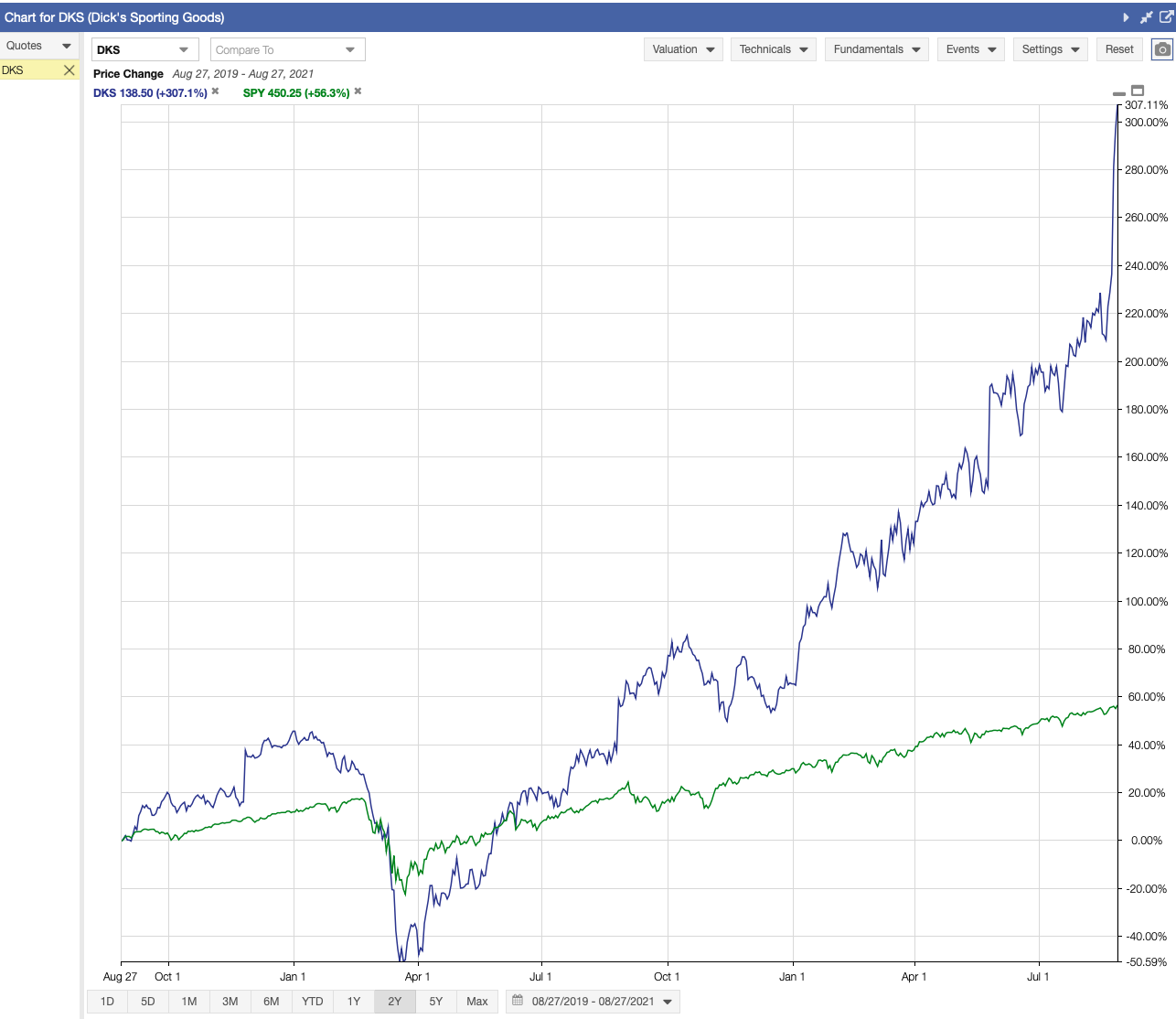
Today I highlight Dick’s Sporting Goods (DKS). The company is currently on a tear and performing well during the pandemic. The stock traded at a low of $18 – $19 in March 2020 during the nadir of the COVID-19 pandemic. The stock price is near a record at $138.50 now. The company raised the regular dividend by 20.7% and announced a $5.50 per share special dividend. The stock is Dividend Challenger with 7 consecutive annual increases. The screenshot below is from Stock Rover*.
Dividend Increases and Reinstatements
I have created a searchable list of dividend increases and reinstatements. I update this list weekly. You can search for your stocks by company name, ticker, and date.
Dividend Cuts and Suspensions List
I updated my dividend cuts and suspensions list at end of August 2021. The number of companies on the list has risen to 530. We are well over 10% of companies that pay dividends having cut or suspended them since the start of the COVID-19 pandemic.
There are three new companiers added to the list this past month. These three companies are Eneti (NETI), International General Insurance (IGIC), and Washington Real Estate (WRE).
Market Indices
Dow Jones Industrial Averages (DJIA): 35,455 (+0.96%)
NASDAQ: 15,130 (+2.82%)
S&P 500: 4,509 (+1.52%)
Market Valuation
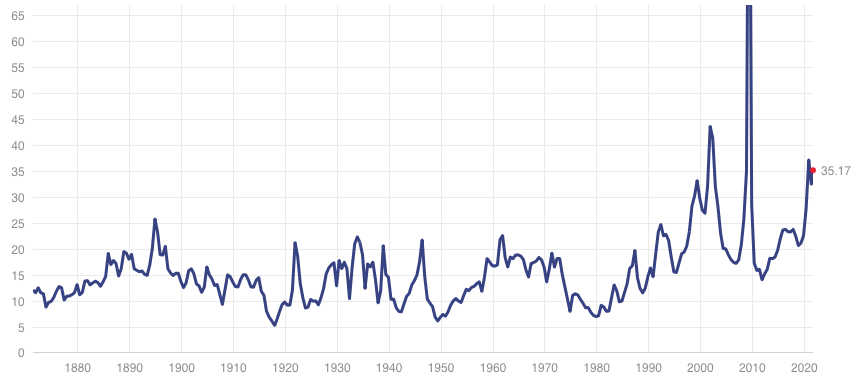
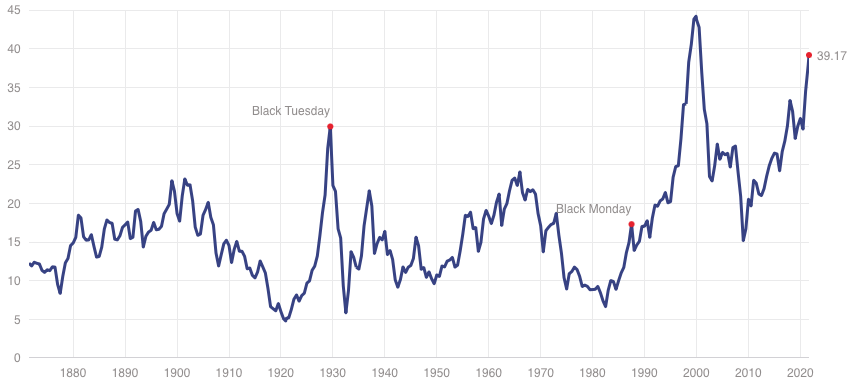
The S&P 500 is trading at a price-to-earnings ratio of 35.2X and the Schiller P/E Ratio is at about 39.2X. These two metrics down the past week. Note that the long-term means of these two ratios are 15.9X and 16.8X, respectively.
I continue to believe that the market is overvalued at this point. I personally view anything over 30X as overvalued based on historical data. The S&P 500’s valuation came down as companies in the index reported solid earnings lapping a Q2 2020 that had depressed earnings.
S&P 500 PE Ratio History
Shiller PE Ratio History
Stock Market Volatility – CBOE VIX
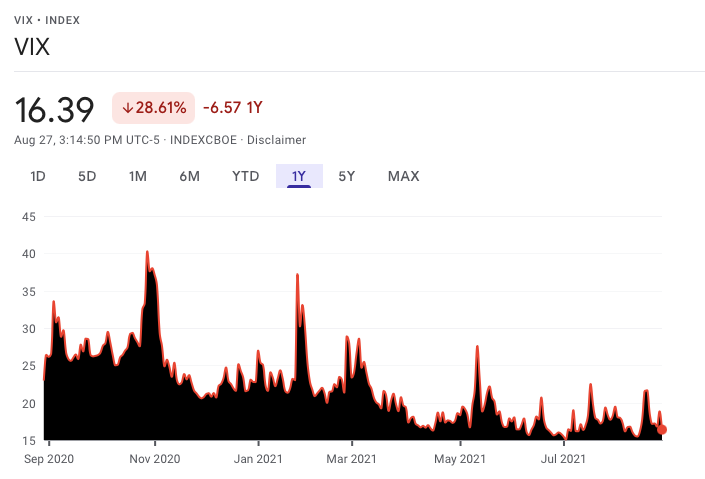
The CBOE VIX measuring volatility was down more than 2 points this past week to 16.39. The long-term average is approximately 19 to 20. The CBOE VIX measure of the stock market’s expectation of volatility based on S&P 500 index options. It is commonly referred to as the fear index.
Fear & Greed Index
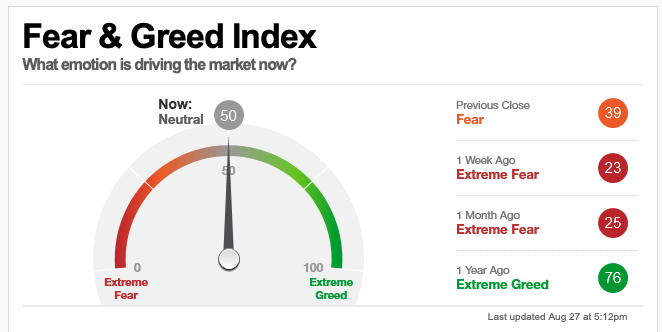
I also track the Fear & Greed Index. The index is now in Neutral at a value of 50. This is up 25 points this past week.
There are seven indicators in the index. They are Put and Call Options, Junk Bond Demand, Market Momentum, Market Volatility, Stock Price Strength, Stock Price Breadth, and Safe Haven Demand.
Junk Bond Demand is indicating Greed. Investors are accepting 1.98% yield over investment grade corporate bonds. The spread is down further from recent levels indicating that investors are taking on more risk.
Market Momentum is indicating Greed. The S&P 500 is 7.10% over its 125-day average. This is further above the average than normal over the past 2-years.
Put and Call Options are signaling Greed. In the last five trading days, put option volume has lagged call option volume by 58.00%. This is still amongst the lowest level of put buying in the past two years.
Safe Haven Demand is in Greed. Stocks have outperformed bonds by 3.08% over the past 20 trading days. This is still close to the weakest performance for stocks over the past 2-years as investors move back into bonds.
Market Volatility is set at Neutral. The CBOE VIX reading of 16.39 is a neutral reading.
Stock Price Breadth is indicating Extreme Fear as declining volume is 6.56% more than
advancing volume on the NYSE during the last month. This indicator is near the lower end of its range over the past two years.
Stock Price Strength is signaling Extreme Fear. The number of stocks hitting 52-week highs compared to those hitting 52-week lows is at the lower end of its range.
Economic News
The U.S. Census Bureau reported that new orders for manufactured durable goods decreased 0.1% to $257.2 billion in July. The decrease follows two consecutive monthly increases. Transportation equipment decreased as well by 2.2% after two consecutive months of increases. Shipments of manufactured durable goods increased 2.2% in July. Unfilled orders for manufactured durable goods increased 0.3% to $1,225.4 billion. Inventories of manufactured durable goods increased 0.6% to $453.6 billion. Total durable-goods orders are up 2.4% from a year ago.
The US Energy Information Administration reported that US commercial crude oil stockpiles decreased by 3.0M barrels from the previous week to 432.6M barrels for the week ending August 20th. U.S. crude oil inventories are running about 6% below the five-year average for this time of year. The EIA reported the gasoline supply decreased by 2.2 M barrels last week and are running about 3% below the five-year average for this time of year. Refineries operated at 92.4% of their operable capacity, as gasoline production increased to an average of 10.2M barrels per day.
The Bureau of Economic Analysis’ second estimate on second quarter gross domestic product (GDP) growth reported an economy expanding at an annual rate of 6.6%, up from 6.3% in the 1st quarter. Increases in personal consumption expenditures, nonresidential fixed investment, exports, and state and local government spending were partially offset by decreases in private inventory investment, residential fixed investment, and federal government spending.
Thanks for reading 4 Things Investors Shouldn’t Care About? – Week in Review!
Here are my recommendations:
If you are unsure on how to invest in dividend stocks or are just getting started with dividend investing. Take a look at my Review of the Simply Investing Report. I also provide a Review of the Simply Investing Course. Note that I am an affiliate of Simply Investing.
If you are interested in an excellent resource for DIY dividend growth investors. I suggest reading my Review of The Sure Dividend Newsletter. Note that I am an affiliate of Sure Dividend.
If you want a leading investment research and portfolio management platform with all the fundamental metrics, screens, and analysis tools that you need. Read my Review of Stock Rover. Note that I am an affiliate of Stock Rover.
If you would like notifications as to when my new articles are published, please sign up for my free weekly e-mail. You will receive a free spreadsheet of the Dividend Kings! You will also join thousands of other readers each month!
*This post contains affiliate links meaning that I earn a commission for any purchases that you make at the Affiliates website through these links. This will not incur additional costs for you. Please read my disclosure for more information.
Prakash Kolli is the founder of the Dividend Power site. He is a self-taught investor, analyst, and writer on dividend growth stocks and financial independence. His writings can be found on Seeking Alpha, InvestorPlace, Business Insider, Nasdaq, TalkMarkets, ValueWalk, The Money Show, Forbes, Yahoo Finance, and leading financial sites. In addition, he is part of the Portfolio Insight and Sure Dividend teams. He was recently in the top 1.0% and 100 (73 out of over 13,450) financial bloggers, as tracked by TipRanks (an independent analyst tracking site) for his articles on Seeking Alpha.
Many investors don’t realize the risks they take when they invest in companies. That is, they don’t know what they should and shouldn’t care about. Whether you’re an individual investor or a business analyst, this article will be of interest to you.