Jack in the Box Inc. (JACK) suspended its dividend because of stressed customers in the current economic environment, competition, and elevated debt and leverage. The fast-food company’s dividend was flat for several years, and thus it had no streak.
The company’s appreciable operational and financial challenges have caused the share price to drop considerably from its peak in June 2021. The share price fell as investors sold this dividend stock because of worries about climbing debt, declining sales, and a potential dividend cut as safety decreased. It will probably be at least several years before the dividend is restored.
Overview of The Jack in the Box Inc
Jack in the Box Inc. is a fast food or quick service restaurant founded in 1951. It owns the Jack in the Box and Del Taco brands. Jack in the Box operates approximately 2,610 restaurants across 22 states, while Del Taco has about 590 restaurants in 17 states. The firm sells burgers, soda, and Mexican food at its businesses.
Total revenue was $1,571 million in the fiscal year 2024 and $1,488 million in the past twelve months.
Dividend Cut Announcement
Before the second quarter fiscal 2025 results announcement, Jack in the Box (JACK) announced on Wednesday, April 23rd, that it will discontinue its dividend payout. The company’s quarterly dividend rate was $0.44 per share before the announcement. The dividend is now $0 per share, a 100% reduction. In the press release on April 23rd, the company stated,
” Jack in the Box will discontinue its dividend effective immediately and direct a majority of those funds toward debt paydown/leverage reduction, with the remainder directed toward share repurchases.”
Later, in the earnings call transcript, the company stated,
“We did not repurchase any shares of stock during the quarter, and as previously announced, we discontinued our dividend. “
Effect of the Change
By eliminating its dividend, Jack in the Box sought to reduce its cash flow obligations to improve its financial position and address elevated debt levels. The firm did not have an annual streak because the quarterly dividend distribution was held constant since the second quarter of 2021. The result is that less free cash flow is required for the dividend payout.
Challenges
Jack in the Box is facing a difficult economic environment in the United States, competition in its two businesses, and too high debt and leverage.
Economic Environment
The current economic environment is putting pressure on Jack in the Box’s core customer. Their customers are stressed from the combination of high inflation and low wage gains since the pandemic. As a result, the company’s traffic, same-store sales, and margins have declined, especially in Del Taco.
Competition
Jack in the Box operates in a competitive environment with several disadvantages. It is not the largest quick service restaurant chain, either for burgers or Mexican food. Consequently, it lacks the scale and efficiencies of companies like McDonald’s or Taco Bell.
Debt and Leverage
The company has elevated debt levels and correspondingly high leverage and low interest coverage. Jack in the Box used debt to fund its aggressive share repurchases under the former CEO. It also incurred debt to purchase Del Taco in 2021. The result is that the net debt is more than $3 billion with a leverage ratio over 5.8X and interest coverage of only 2.8X.
Dividend Safety
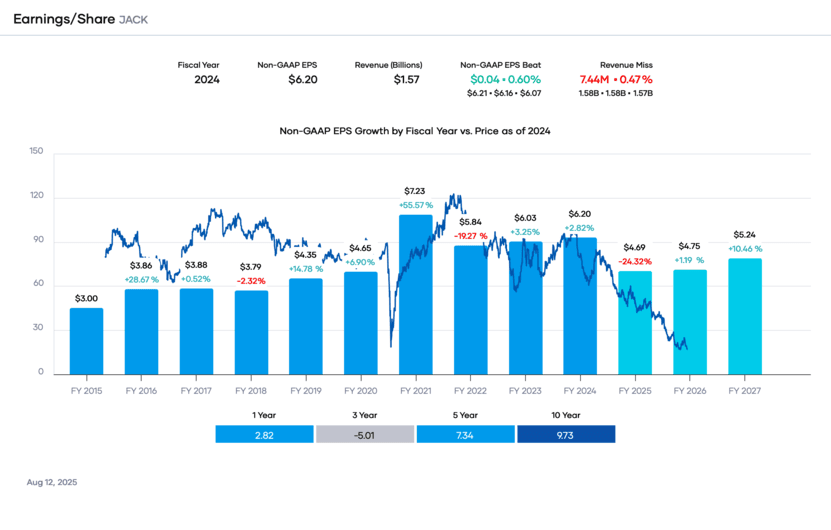
Jack in the Box’s dividend safety was declining because of lower revenue and earnings per share. Earnings per share peaked in fiscal year (FY) 2021 at $7.23 but plunged dramatically to $5.84 in 2022. It gained slightly over the next two years. However, they are expected to fall further to $4.69 per share in FY 2025.
As a result, as seen in the chart below from Portfolio Insight*, the dividend yield climbed rapidly to about 10%. This percentage is a value usually associated with a distressed company. Also, it is much greater than the 5-year average of 2.73%. After discontinuing, the forward yield is around 0%. The quarterly rate is $0 per share.

Before the dividend was eliminated, both earnings and free cash flow per share adequately covered the dividend. However, the firm’s declining revenue and EPS, and rising leverage resulted in a dividend quality grade of F’ from Portfolio Insight. Hence, Jack in the Box is in the bottom percentile of dividend stocks tracked. We view the equity as at risk for another dividend cut.
Final Thoughts on the Jack in the Box (JACK) Dividend Suspended
Jack in the Box was paying a dividend, but it was not being increased. Instead, the focus was on stock buybacks driven by debt issuance. Current economic conditions, a stressed consumer, and still too high debt levels mean the firm will probably focus on its balance sheet for at least several quarters. That said, it may take even longer for store traffic, same-store sales, and earnings to recover and grow. In any case, the severity of Jack in the Box’s challenges caused it to suspend its dividend.
Related Articles on Dividend Power
- Carter’s Dividend Cut Because of Tariffs and Uncertain Market Conditions
- The Smart Investor’s Playbook for Avoiding Dividend Cuts
Here are my recommendations:
Affiliates
- Simply Investing Report & Analysis Platform or the Course can teach you how to invest in stocks. Try it free for 14 days.
- Free Dividend Kings Spreadsheet from Sure Dividend, complete with Buy/Hold/Sell recommendations, dividend histories, and much more. It is an excellent resource for DIY dividend growth investors and retirees.
- Stock Rover is the leading investment research platform with all the fundamental metrics, screens, and analysis tools you need. Try it free for 14 days.
Receive a free e-book, “Become a Better Investor: 5 Fundamental Metrics to Know!” Join thousands of other readers !
*This post contains affiliate links meaning that I earn a commission for any purchases that you make at the Affiliates website through these links. This will not incur additional costs for you. Please read my disclosure for more information.
Prakash Kolli is the founder of the Dividend Power site. He is a self-taught investor, analyst, and writer on dividend growth stocks and financial independence. His writings can be found on Seeking Alpha, InvestorPlace, Business Insider, Nasdaq, TalkMarkets, ValueWalk, The Money Show, Forbes, Yahoo Finance, and leading financial sites. In addition, he is part of the Portfolio Insight and Sure Dividend teams. He was recently in the top 1.0% and 100 (73 out of over 13,450) financial bloggers, as tracked by TipRanks (an independent analyst tracking site) for his articles on Seeking Alpha.